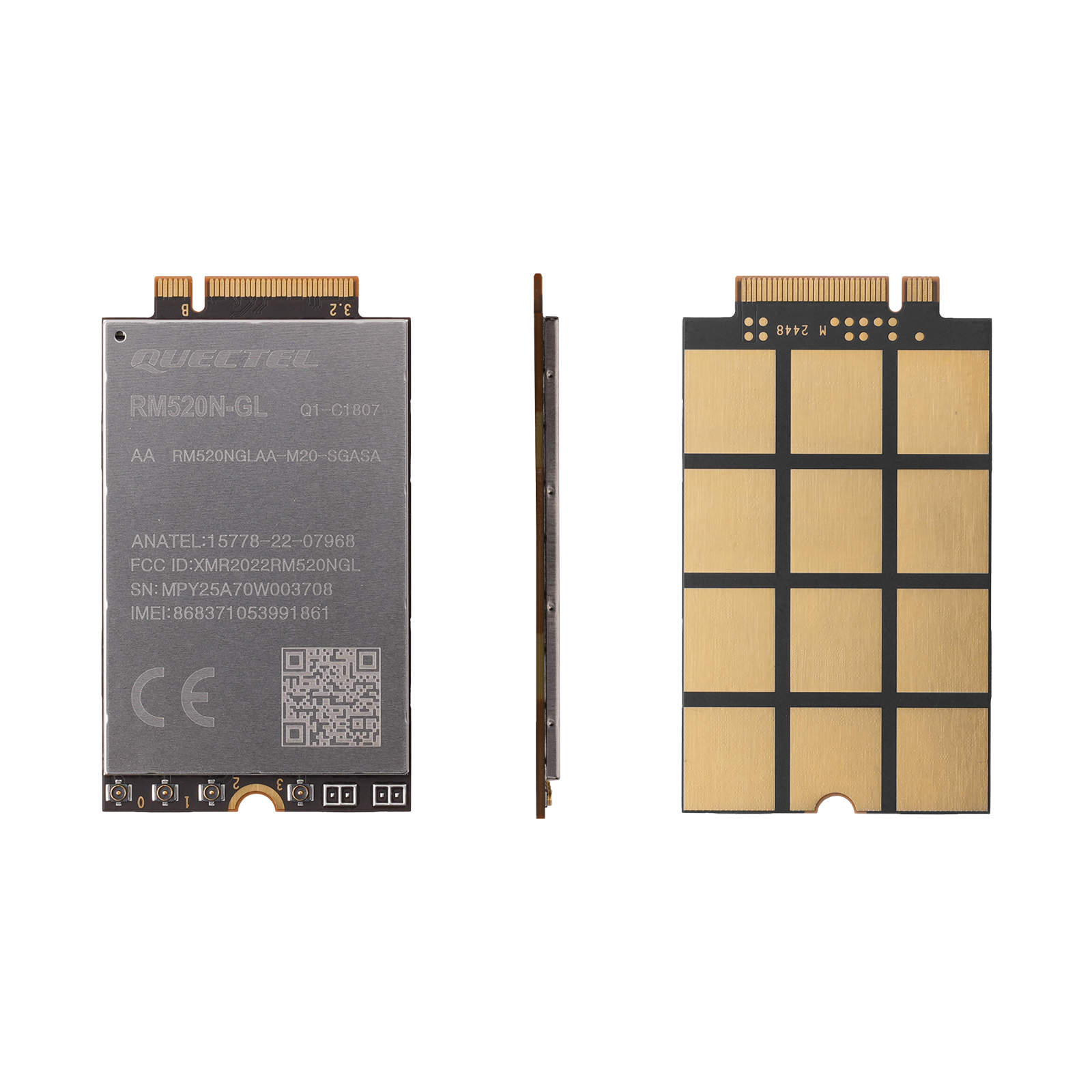
5G Module
Product Features
Core Features
- Network Modes: Supports 5G NR Sub-6GHz (SA/NSA), LTE-FDD/TDD, WCDMA/HSPA+.
- Interface Type: M.2 Key B, supporting PCIe 3.0 x4 and USB 3.1 Gen2.
- GNSS: Integrated multi-mode positioning (GPS/GLONASS/BeiDou/Galileo/QZSS), supporting L1+L5 dual-frequency (requires AT commands or hardware control).
- HPUE Enhancement: Supports Class 2 power level (26 dBm), improving cell-edge coverage.
- Industrial-Grade Design: Operating temperature -40°C to +85°C, dimensions 30×52×2.3mm.
Model Comparison
| Model | Supported Bands | HPUE Bands | GNSS |
|---|---|---|---|
| RM520N-GL | 5G: n1/n3/n5/n7/n28/n38/n40/n41/n77/n78/n79; LTE: B1/B3/B5/B7/B8/B20/B28/B38/B40/B41 | n38/n41/n77/n78/n79 | L1+L5 (reserved) |
| RM520N-EU | 5G: n1/n3/n7/n28/n41/n77/n78; LTE: B1/B3/B7/B8/B20/B28/B41 | n41/n77/n78 | L1+L5 |
| RM520N-CN | 5G: n41/n78/n79; LTE: B1/B3/B5/B8/B41 | n41/n78/n79 | L1+L5 |
Specifications
Electrical Characteristics
| Parameter | Specification |
|---|---|
| Supply Voltage | 3.135V–4.4V (typical 3.7V) |
| 5G Peak Power | 3.5A @ 3.7V (256QAM modulation) |
| LTE Peak Power | 2.0A @ 3.7V (256QAM modulation) |
| Operating Temperature | -40°C to +85°C (industrial-grade) |
| Storage Temperature | -40°C to +90°C |
| ESD Protection | Contact discharge ±5kV, air discharge ±10kV |
RF Performance
| Network Type | Band | Downlink Rate | Uplink Rate | MIMO Configuration |
|---|---|---|---|---|
| 5G NR | n41/n78 (dual carrier aggregation) | 2.5 Gbps | 900 Mbps | 4×4 MIMO |
| LTE | B41 (5CA) | 2 Gbps | 200 Mbps | 4×4 MIMO |
Interface Specifications
| M.2 Key B | Specification |
|---|---|
| PCIe 3.0 | 4 lanes (x4 Lane), theoretical bandwidth 32 Gbps, supports NVMe protocol. |
| USB 3.1 Gen2 | 10 Gbps data rate, backward compatible with USB 2.0, supports UVC protocol extension. |
| (U)SIM | Dual SIM single standby, 1.8V/3.0V compatible, supports hot-swap (requires AT+QSIMDET enable). |
Usage Instructions
-
Interface Configuration
- PCIe Mode Switch:
AT+QCFG="pcie/mode",1    // Switch to RC mode
AT+QCFG="pcie/bandwidth",1 // Configure x4 lanes - GNSS Control:
AT+QGPS=2          // Enable L1+L5 dual-frequency positioning
AT+QGPSEND        // Disable GNSS
- PCIe Mode Switch:
Precautions
Key Design Considerations
-
Power Stability
- Transient voltage must be ≤50mV (use low ESR capacitors to suppress ripple).
- Do not cut power directly; use
AT+QPOWDfor soft shutdown or pullFULL_CARD_POWER_OFF#low for at least 900ms.
-
ESD Protection
- All interfaces must include TVS arrays (junction capacitance ≤10pF).
- SIM card trace length ≤200mm, with 22Ω series resistors for EMI suppression.
-
Thermal Management
- Under high load, attach thermal pads (thermal conductivity ≥5W/mK) or heat sinks (covering the module shield can).
- Avoid proximity to heat sources; PCB exposed copper area ≥50%.
Safety and Maintenance
-
Prohibited Operations
- Avoid ultrasonic cleaning (may damage crystal); power off before cleaning with alcohol.
- In high-temperature environments (>85°C), derating is required; disable HPUE mode.
-
Firmware Upgrade
- Upgrade via USB 3.1 or PCIe interface; ensure stable power supply (voltage ≥3.3V).
Appendix
-
Mechanical Dimensions: 30.0mm × 52.0mm × 2.3mm (M.2 Key B); reserve ≥2.5mm clearance for the thermal area.
-
Key AT Commands:
AT+CFUN=4        // Enter flight mode
AT+QSCLK=1       // Enable sleep mode
AT+QCFG="data_interface",0,0 // Switch back to USB mode