What is NeoMind?
NeoMind is an edge-deployed AI platform that brings intelligence to IoT. It runs LLM-powered agents directly on your hardware, connects to devices via MQTT / BLE / Webhook, automates responses through a rule engine, and visualizes everything on real-time dashboards — all without relying on cloud services.
Key idea: Talk to your devices in natural language. The AI understands your intent, queries device states, creates automation rules, and takes action autonomously.
Product at a Glance
Three core surfaces of NeoMind — manage your devices, visualize your data, and drive everything through natural language.
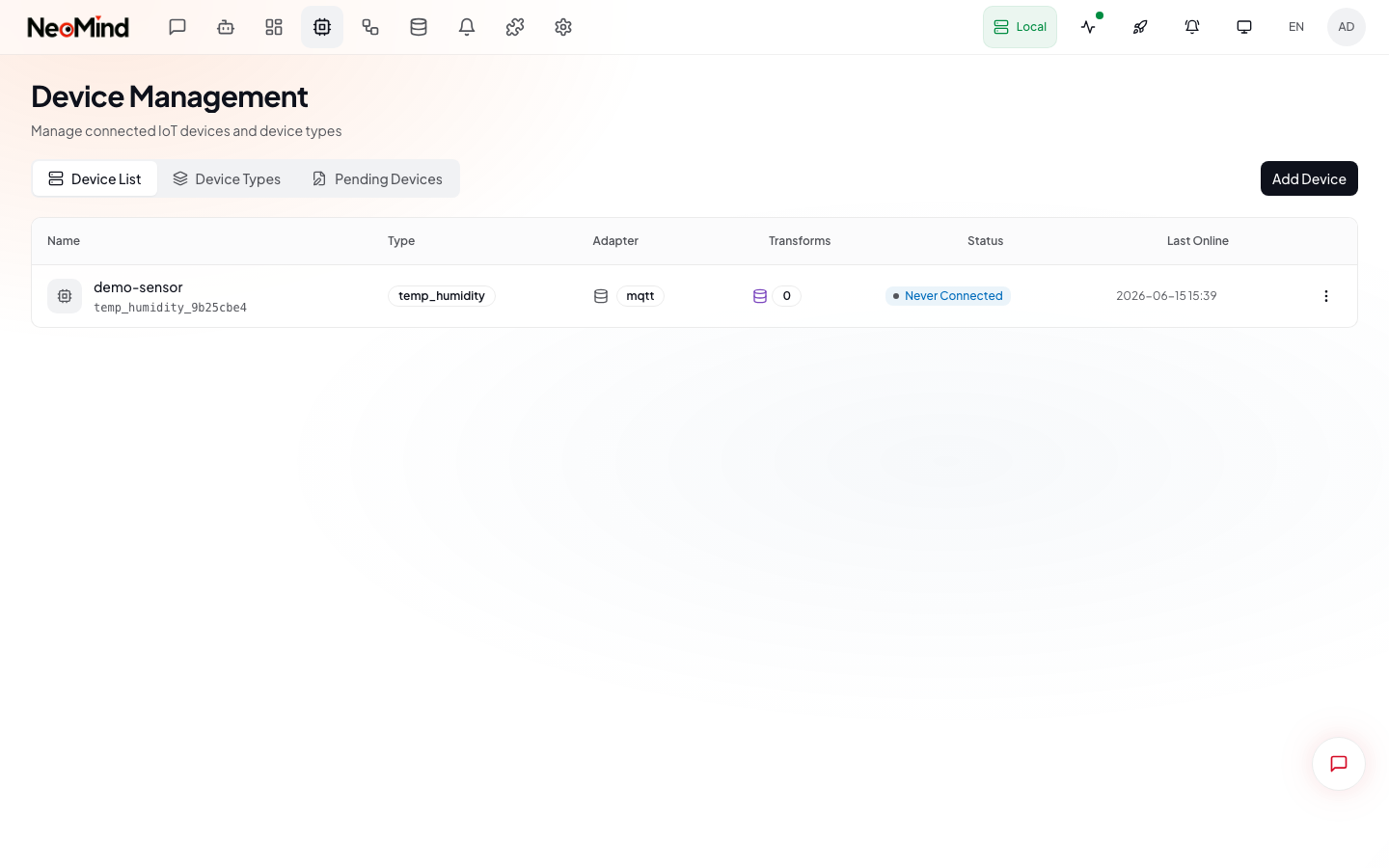
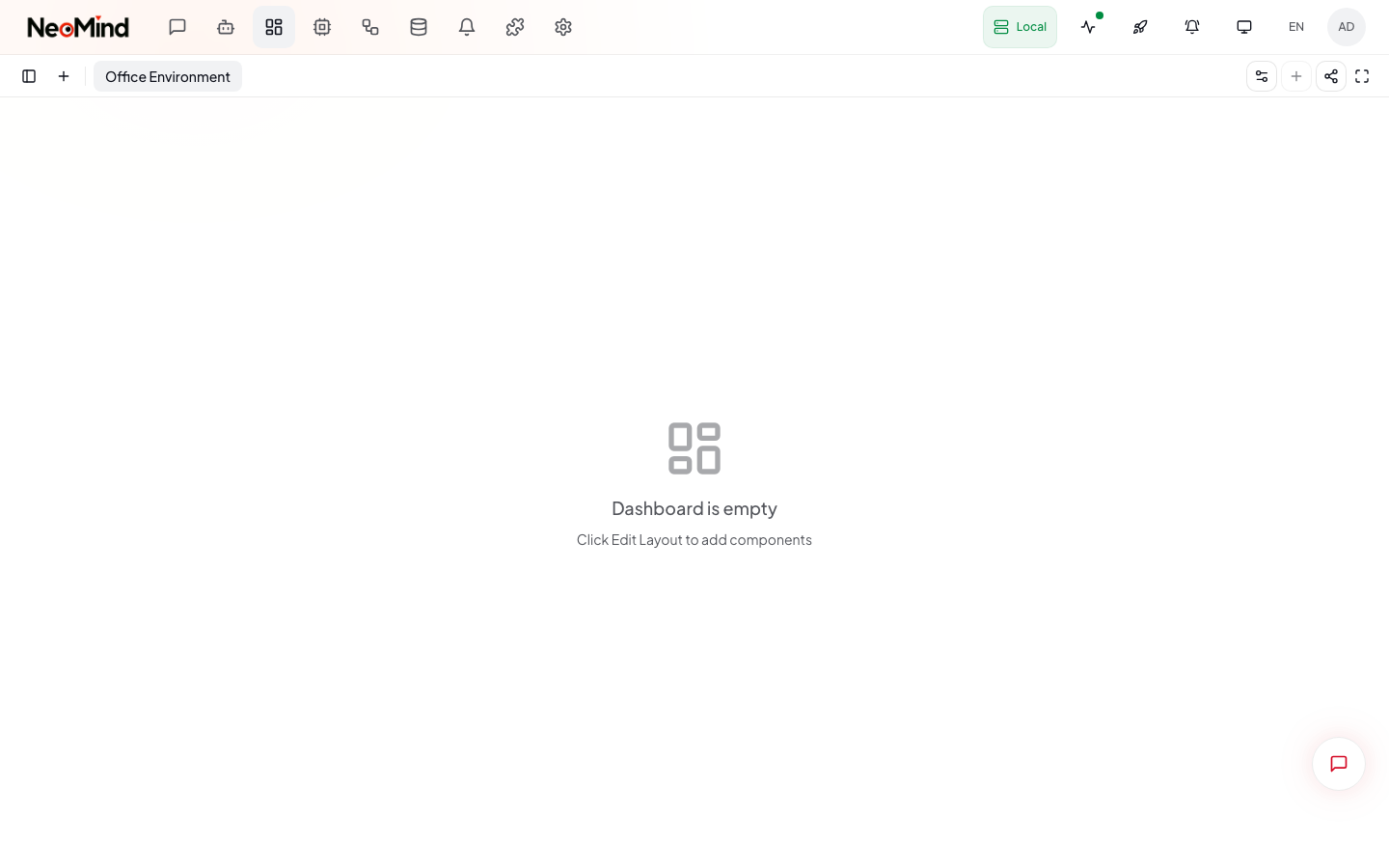
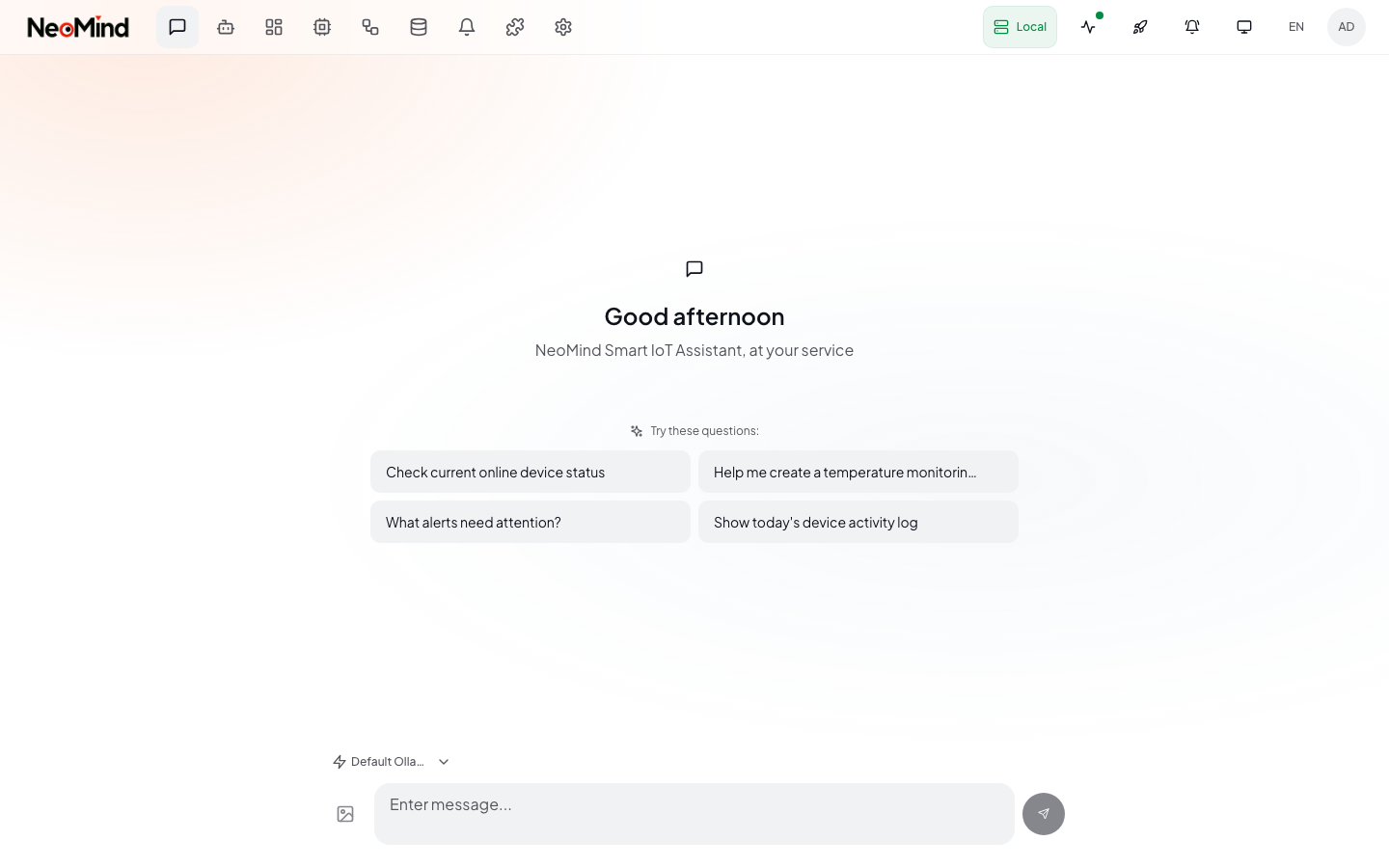
Product Architecture
NeoMind uses a single-process, multi-layer architecture — all core capabilities are packaged in one process, with no external database or message broker required. It's ready the moment you start.
-
Single-Process, Self-Contained — API, MQTT broker, storage, and rule engine all live in one process. A single
cargo runand everything is ready. No Docker compose, no external dependencies. -
Edge-First, Cloud-Optional — Defaults to local LLMs (Ollama) for 100% offline operation — data never leaves your LAN. When you need more power, switch to cloud models (OpenAI / Claude / GLM) with one click.
-
Crash-Isolated Extensions — Extensions run in separate processes and communicate via FFI. A YOLO extension crashes? The main service and other extensions are completely unaffected.
Want to go deeper into each layer's design? Read Core Concepts — full breakdown of the data lifecycle, extension model, and agent execution loop.
Why NeoMind?
| Feature | Description |
|---|---|
| Fully self-contained | Embedded MQTT broker, redb storage, no external database or broker to install |
| Type-safe end-to-end | Rust backend with compile-time guarantees; agent CLI commands dispatch in-process with structured data, no fragile string parsing |
| Crash-proof extensions | Extensions run in isolated processes with capability-based permissions; a misbehaving extension never takes down the server |
| Cloud-optional | Works 100% offline with local LLMs (Ollama), or connect cloud models when you need more power |
Core Capabilities
AI Intelligence
- Natural Language Chat — Conversational interface to query and control all connected devices
- Autonomous Agents — Scheduled or event-driven AI agents that monitor, analyze, and act on device data independently
- 10+ LLM Backends — Ollama, OpenAI, Anthropic, Google, xAI, Qwen, DeepSeek, GLM, MiniMax, and any OpenAI-compatible endpoint
- Memory System — Multi-tier memory (Profile / Knowledge / Tasks / Evolution) with automatic extraction and compression
- Skill System — YAML + Markdown skill files that guide agent behavior for specific scenarios
- Multimodal — Image upload and visual analysis support
Device Management
- MQTT Protocol — Primary device integration with embedded broker, mTLS, and CA certificate support
- BLE Provisioning — Zero-touch device setup via Bluetooth (Tauri native + Web Bluetooth)
- HTTP / Webhook — Flexible REST-based device adapter
- Auto-Discovery — Automatic device detection, type registration, and AI-assisted onboarding
- Command Queue — Send control commands to devices with parameter validation and tracking
- Custom Device Types — Define device metrics and commands via JSON type definitions
Automation
- JSON Rule Engine — Structured rule definitions:
{"condition": {"source": "device:sensor:temperature", "operator": "greater_than", "threshold": 30}} - Data Transforms — JavaScript-based data transformation for creating virtual metrics
- Scheduled Agents — Time-based or event-driven AI agent execution
- Event Bus — Pub/sub architecture for decoupled component communication
Dashboards & Visualization
- Drag-and-Drop Builder — Visual dashboard editor with responsive grid layout
- Rich Widgets — Value cards, charts, gauges, tables, VLM vision components
- Real-time Updates — WebSocket / SSE for live data streaming to dashboards
- Dashboard Sharing — Public links with expiration
- Custom Components — Build and publish your own dashboard widgets
Notification & Data Push
- 7 Notification Channels — Webhook, Email, Telegram, WeCom, DingTalk, Slack, Feishu
- Data Push — Forward telemetry data to external systems via Webhook or MQTT
- Delivery Tracking — Exponential backoff retry, delivery history, and log management
- Message Deduplication — Prevent notification storms from high-frequency triggers
Platform
- Multi-Instance — Connect to and manage multiple NeoMind backends from a single interface
- Extension System — Native & WASM extensions with process isolation and capability-based permissions
- Cross-Platform Desktop — macOS, Windows, Linux native apps via Tauri
- Mobile-Friendly Web — Responsive web UI optimized for phone and tablet
- i18n — English and Chinese
- Dark Mode — System-aware dark/light theme
- API Key Auth — Alternative to JWT for programmatic access
- CLI Tools — Full-featured command-line interface
Ecosystem
NeoMind is a modular ecosystem with specialized repositories for each concern:
| Repository | Purpose |
|---|---|
| NeoMind | Core platform — backend, frontend, desktop app |
| NeoMind-Extensions | Official extension marketplace — weather, YOLO detection, OCR, face recognition, streaming |
| NeoMind-DeviceTypes | Device type definitions — standardized metrics and commands for IoT hardware |
| NeoMind-Dashboard-Components | Dashboard widget marketplace — community-contributed React components |
Who It's For
- IoT integrators / solution engineers — Need to rapidly build edge intelligent solutions connecting cameras, sensors, and controllers with automation
- Industrial / campus / retail operators — Want to manage devices, configure alerts, and visualize data in natural language
- Secondary developers — Extend the platform via the Extension SDK, custom device types, or dashboard components
- AI application engineers — Run multimodal LLM agents at the edge, connected to real physical devices
Next Steps
- 5-Minute Quick Start — Experience the core loop in record time
- Core Concepts — Understand the system overview and data flow
- Glossary — Central definitions for all core terminology
- Install & Setup — Get NeoMind running on desktop or server
- Configure LLM Backend — Connect Ollama or cloud models
- Onboard a Device — Use the onboarding wizard
- AI Agent — Create autonomous agents
- Automation Rules — JSON rule engine
- Extensions — Install vision AI / OCR extensions
- Developer Guide Overview — Start from one of four dimensions: device types / extensions / dashboard components / main project
- Use Cases — End-to-end scenario examples
Last updated: 2026-06-15